#420 Jim Maloney


Condition: EX+, off-center but otherwise pretty crisp and trivia answer is not revealed.
Trivia question: “Which pitcher won 24 straight ballgames?”
Topps got this one right, and it’s still the correct answer. Carl Hubbell of the Giants won 24 consecutive decisions starting on July 17, 1936, and ending on May 27, 1937. He did have three no-decisions in there, but the Giants won those three games anyway.
Hubbell was a rare baseball lifer with one organization. He pitched for the Giants from 1928-43, then spent the next 45 years working for the team until his death in a car accident in 1988.
A few things about Jim Maloney:
* Maloney was one of the top pitchers of the ’60s who’s mostly forgotten now. If not for an Achilles injury in 1970 that basically ruined his career, he could potentially have been a Hall of Famer. Because of the devastating injury, he was unable to play for the Reds that dominated the N.L. in the 1970s. But from 1963 through 1969, he went 117-60 with a 125 ERA+, 29 shutouts and two no-hitters (plus a third that doesn’t technically count).
* Speaking of no-hitters, Maloney is one of only seven pitchers to throw a no-hitter against the Cubs. On August 19, 1965 he threw 10 no-hit innings at Wrigley Field and the Reds won 1-0. Maloney walked 10(!) but managed to not let any of them score. His other official no-hitter came on April 30, 1969, a 10-0 win over Houston.
* So what about the no-hitter that didn’t count? On June 14, 1965, Maloney threw 10 no-hit innings against the Mets but gave up a home run to lead off the 11th (and eventually gave up another hit) and he lost the game 1-0. He struck out 18 and walked just one, giving him a game score of 106 (one of the highest of all-time).
* Maloney was coming off a big year in 1963, in which he went 23-7 with a 2.77 ERA and 265 strikeouts in 250.1 innings. He followed it up in 1964 with an even-better 2.71 ERA (133 ERA+) but his record dipped to 15-10. By WAR, 1965 was his best season, and also his only all-star selection. He threw a career-high 255.1 innings, with a 2.54 ERA (148 ERA+) and only 6.7 H/9 allowed. That was good for an 8.2 pitching WAR, which was second in the N.L. behind Juan Marichal. Alas, Sandy Koufax with his 26 wins, 2.04 ERA and (then) major league-record 382 strikeouts swept all 20 Cy Young votes (somehow, Koufax’s WAR was 8.1).
* After his major Achilles injury in 1970, the Reds traded Maloney to the Angels for pitcher Greg Garrett, who appeared in two games in 1971 and never pitched in the majors again. Maloney himself pitched in 13 games (30.1) innings for California in 1971 and hung it up at the age of 31.
* As of August 2018 Maloney is still alive and reportedly lives in his hometown of Fresno, California. He’s currently 78 years old.
#406 Al Spangler


Condition: Probably VG-EX, but could possibly be considered EX. The trivia answer is not rubbed off.
Trivia question: Which team lost 3 games in one day?
The answer given is the 1903 Dodgers, but according to Baseball Reference there is no record of the Dodgers ever playing three games in a day in 1903. I looked at a few seasons before and after and didn’t find any evidence of any tripleheaders.
A Brooklyn team (the Bridegrooms) did play a tripleheader once, but it was in 1890 and Brooklyn won all three games vs. the Pittsburgh Alleghenys.
So I guess we’ll never know where Topps got this question and answer from.
A few things about Al Spangler:
* Al Spangler is the definition of an average hitter. His OPS+ was exactly 100 for his 13-year MLB career. He had no power (21 career HRs in 2,616 plate appearances) but hit .262 and walked frequently enough to have a .347 career OBP.
* Spangler, mostly a left fielder, played parts of three seasons with the Braves. He was then picked in the expansion draft by the Houston Colt .45s, and was their best hitter by by OPS over the team’s dismal first two seasons in 1962 and ’63. He wasn’t spectacular, but by Houston standards a .283/.372/.387 slash line was outstanding. He was the only Colt regular with an OPS over 100 in 1963 (120).
* Al was with Houston until midway through the 1965 season, so he got to be a part of the first Astros team. He was then traded to the Angels, who had also just changed their name from the LA Angels to the California Angles.
* He was never a regular starter again, and he spent five seasons as a backup with the Cubs before retiring in 1971 at the age of 37.
* Spangler was a AA manager in the Cubs organization for two season in the 1970s, but that seems to be the end of his involvement in baseball. As of July 2018, Spangler is still alive and well at the age of 85.
#574 Manny Jimenez


Condition: VG-EX. It’s way off-center and has a few small surface wrinkles, but still presents well. Trivia answer is not rubbed off.
Trivia question: “What club played a season with 5 pitchers?”
Though it’s not scratched off, if you shine a light on the card just right you can see that the answer given is the 1904 Red Sox. This is true, but one major detail is wrong. Yes, the American League team from Boston did go an entire season in 1904 using just five pitchers. But that team was not yet known as the Red Sox. From 1901 through 1907, the Boston A.L. team was called the “Americans” and had blue as their primary color.
Boston won the A.L. that season with a five-man pitching staff of Cy Young, Jesse Tannehill, Bill Dinneen, Norwood Gibson and George Winter. After winning the inaugural World Series in 1903 over Pittsburgh, Boston was not given a chance to repeat as John McGraw’s New York Giants, the ’04 N.L. champs, refused to play an “exhibition” series against the “inferior” league. The dispute led to the formalization of the agreement of the two league champions to play each other, and they’ve done it every year since 1905 (except, of course, 1994).
A few things about Manny Jimenez:
* This card is a high number, making it more valuable than other cards in the set. But of the high numbers (523-587), it’s the second-easiest to find in premium condition. There are 52 PSA 9s of this card, which is more than any high number other than the Phil Niekro rookie card.
* Manny Jimenez had one pretty good year in MLB, and that was his rookie season of 1962. He had nearly half of his career plate appearances that season, and he hit .301/.354/.428 with 24 doubles, 11 homers and 69 RBIs for the A’s.
* After hitting 0 home runs in part-time action in 1963, Jimenez saw his last significant action in the majors in 1964. Though he batted only .225, he bested his rookie year by hitting 12 homers in 225 plate appearances. The best game of his career was July 4, 1964, when he hit three home runs in a 6-6 tie against Baltimore. He hit two more homers in an 11-4 loss to the White Sox on July 12. But by mid-August he was no longer a starter and basically faded away from there.
* Manny spent all of 1965 and most of 1966 in the minors. He had a quite respectable .742 OPS in 135 PA over two seasons with the Pirates, and closed out his MLB career by going 1-for-6 with the Cubs in 1968. He finished his career with a decent-enough 101 OPS+ but had a -1.0 career WAR due to being a below-average left fielder.
* Jimenez was from San Pedro de Macoris in the Dominican Republic. He was the 10th Dominican to appear in a major league game. His brother, Elvio, was the 16th Dominican player, but Elvio appeared in just one game for the Yankees, on October 4, 1964.
* I wasn’t able to find much specific information about his later life, but Manny passed away on December 11, 2017, in New York City. He was 79 years old.
#41 Friendly Foes


Condition: VG (corners and edges are pretty good, but the creases are pretty hard to ignore)
Trivia question: No trivia question on these combo cards.
A few things about “Friendly Foes”:
* This is one of a number of “combo cards” in the set that feature some current players, most of which are random enough to make you wonder why Topps thought these particular photos were worthy of making into a card.
* This picture was taken at the 1963 All-Star Game in Cleveland. This was the last of Wagner’s three ASGs, and he went 2-for-3 as a starter in the game. McCovey struck out in his only plate appearance as a pinch hitter in the first of his six ASGs.
* These two guys did have some history together. Wagner started out with the Giants in 1958 and had a good year, but regressed in 1959. Meanwhile, McCovey joined the Giants in 1959 and became the NL Rookie of the Year. In that offseason, Wagner was traded to St. Louis.
* Though Wagner is wearing a Los Angeles Angels jersey here, he was traded after the 1963 season to Cleveland. He’s wearing an Indians cap in his regular-issue card from the 1964 set (card #530).
* Speaking of jerseys, this is a really good look at an Angels home jersey and cap as they looked in the original LA era. Though the hat looks black in the photo, it’s actually a dark blue with the red lettering. The Angels would become the California Angels in 1965 and in 1966 they moved from Dodger Stadium to Anaheim Stadium, where they still play today. McCovey is of course wearing the classic Giants road jersey, which is basically the same thing they wear now.
* There’s much more to say in the posts for their individual cards, but these two took very divergent paths after this photo. McCovey of course became an all-time great and first-ballot Hall of Famer with an entire body of water named after him. Wagner was a decent player who hit 173 homers from 1961-66, and though he had a brief acting career after he retired his life was eventually overcome by addiction. He was homeless and broke when he died on the streets of Los Angeles in 2004.
#443 Chuck Dressen


Condition: EX
Trivia question: There’s no trivia question on the manager cards
A few things about Chuck Dressen:
* Dressen is the second-oldest person depicted on a 1964 Topps card. Dressen was born September 20, 1898, making him 65 during the 1964 season. Only Mets manager Casey Stengel (who was born in 1890) was older among those who have a 1964 card.
* He’s mostly known as being the manager for the Brooklyn Dodgers during the “Boys of Summer” days of the early 1950s. He managed the Dodgers during the infamous 1951 season, when the Giants came from 12-1/2 games behind in August to edge the Dodgers in a tiebreaker on the “Shot Heard ‘Round the World.” He won consecutive pennants with the Dodgers in 1952 and ’53, but lost the World Series to the Yankees both years. He was managing the dismal Washington Senators when the Dodgers finally won the championship in 1955.
* Dressen wasn’t much of a player, but he did play in seven seasons with the Reds, mostly as a third baseman. He didn’t debut until 1925, when he was 26 years old. He immediately became a manager in the minor leagues after his playing career ended, but ended up signing to play off the bench for the Giants late in the 1933 season. Dressen took on a coach-like role and won a title with New York despite not playing in the World Series.
* He played quarterback in the NFL for three seasons, one with the Decatur Staleys and two for the Racine Legion.
* Dressen was hired to manage the Tigers in the middle of the 1963 season. He suffered a heart attack in spring of 1965 and missed the first 42 games of the season. He then had another heart attack early in the 1966 season, and never fully recovered, dying in August 1966 at the age of 67.
I finished!
After five years of buying, selling and trading cards, I have finally completed the full 1964 Topps set. Now comes the task of upgrading some of the cards I have that are in less than VG condition. Overall, I think the set averages VG-EX, with quite a few better and quite a few worse.
I’ve enjoyed spending some of my spare time over the last few years constructing the posts here, but they take me quite a while to write, so I think I’m going to take some cues from some blogs I’ve seen for other sets and focus on writing some shorter posts with a few bullet points for each card so I can get through them a bit quicker. Otherwise I’ll be doing this blog until about 2060.
One of the things I love about this project is that I wasn’t born until 1977, so many of the players in this set are guys I don’t know a whole lot about. Everyone knows about the stars of this era, but it’s really cool to go back and learn about the players who filled out MLB rosters in 1964.
It should be noted that there are two high-profile absences from the 1964 set. Both Maury Wills and Chris Short did not have cards in this set. In fact, neither guy was pictured on a Topps card until 1967 despite being well into their major league careers. I’m not sure why Short, a decent pitcher in his time, isn’t represented. There’s long been a rumor that Wills declined to sign with Topps early in his career because he was unhappy about being passed over for a card in what turned out to be his rookie season. But that wasn’t exactly true. When Topps was signing players in 1959, Wills was in camp with the Detroit Tigers and not considered to be an MLB-quality player, so Topps didn’t bother signing him to a deal. When Wills ended up being sent back to the Dodgers and making the team, he instead signed an exclusive contract with Fleer (which ended up not working out that well, since Fleer only put him on a card in 1963). He and Topps both deny there was any bad blood, and say Fleer simply got to him first.
#87 St. Louis Cardinals
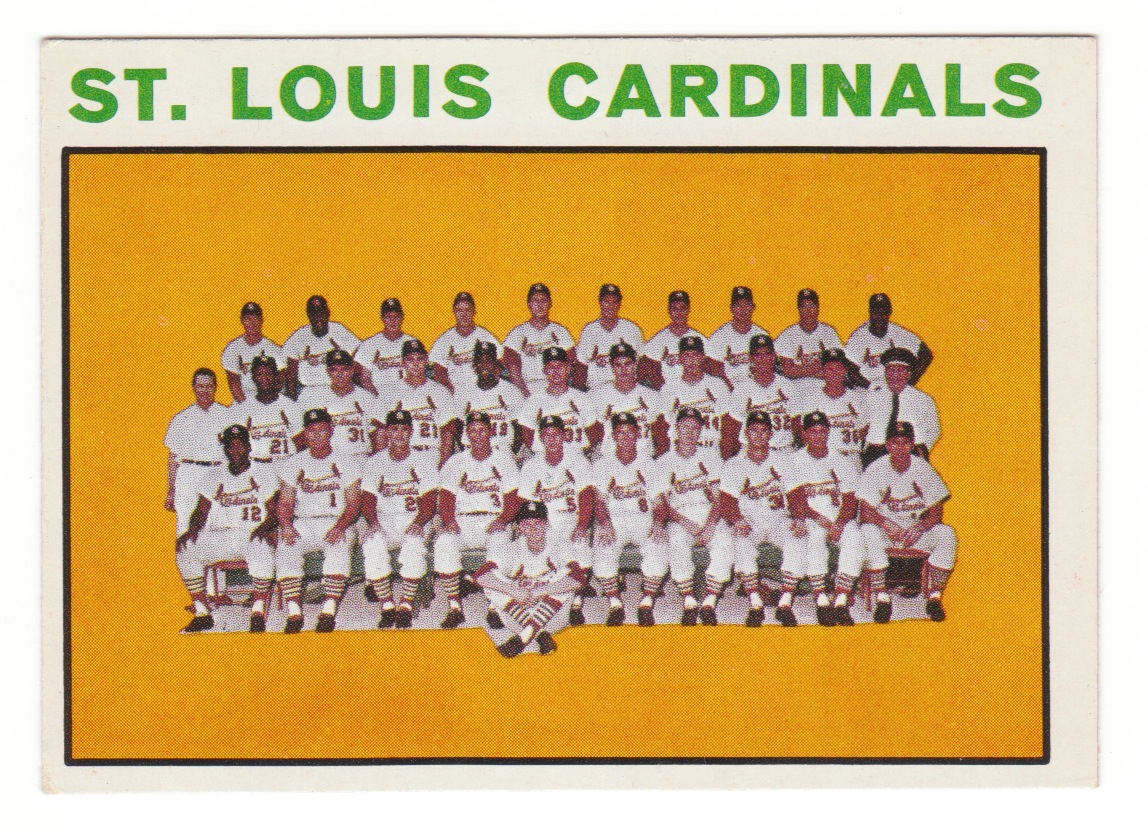
Since these team cards feature the roster photo from the previous year’s team, this Cardinals card is the last Topps card to feature Stan Musial as an active player. He’s in the front row, fifth person in from the right. Musial retired after the 1963 season, so he’s otherwise not featured in the ’64 set. Red Schoendienst is also in this photo, third from left. He also retired in 1963.
The team cards from this set are hard to find well-centered and often are cut crooked. My version of this card is actually in pretty good shape, at least an EX and probably EX-MT.
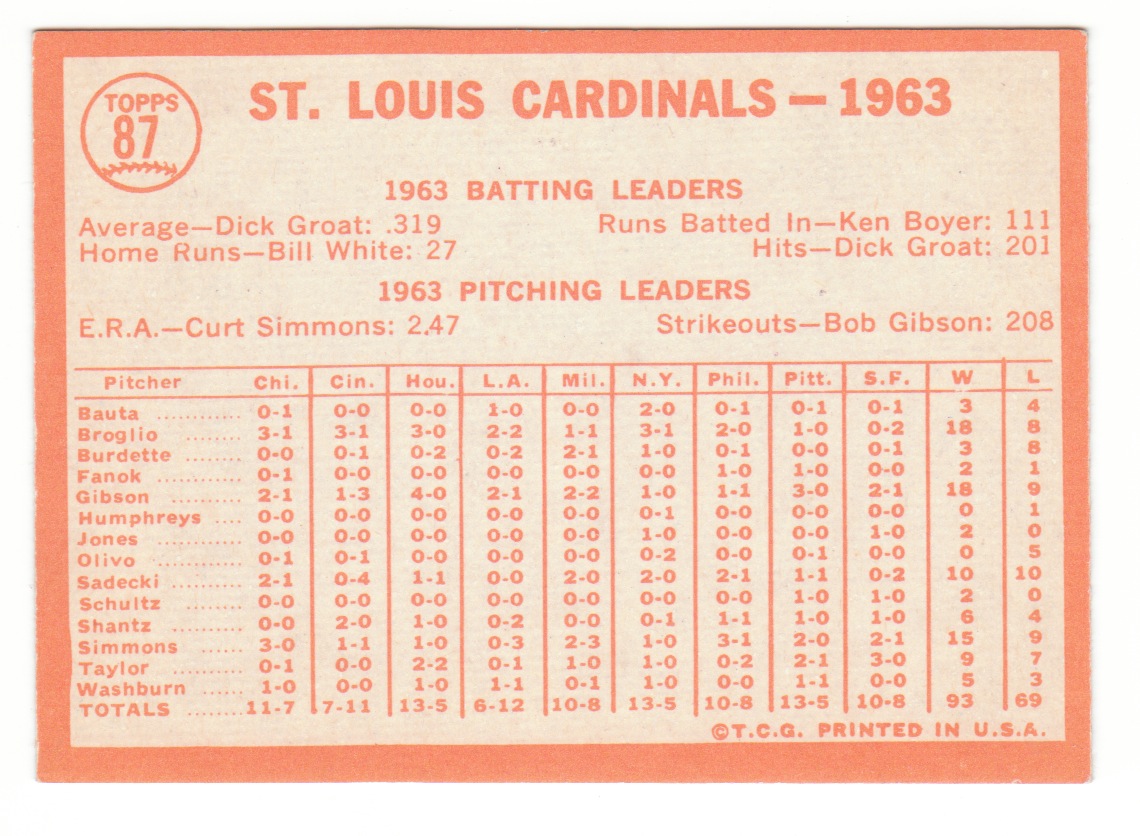
These cards recap the team leaders from 1963 on the top part of the back of the card, then shows the W-L record of each pitcher against each team in the league.
While this card shows 1963 numbers, I’m using the team card posts to talk about each team’s 1964 season.
The Cardinals, as you may know, won the World Series in 1964 in a dramatic seven-game series against the New York Yankees. With the Cards trailing the series 2-1, NL MVP Ken Boyer hit a grand slam in Game 4 to give St. Louis a 4-3 win and turn momentum back in their favor.
Game 5 was another classic, with the Cards blowing a 2-0 lead in the bottom of the ninth at Yankee Stadium, as Tom Tresh hit a game-tying two-run homer with two out after Mickey Mantle had reached on a Dick Groat error. The Cards somehow shook it off, and 22-year-old catcher Tim McCarver (decades before annoying World Series viewers on Fox) hit a three-run homer in the top of the 10th to win the game. Yankee Stadium wouldn’t host another postseason game until 1976.
The series went back to St. Louis, but the Yanks didn’t go quietly. Roger Maris and Mantle hit homers to put New York ahead, then Joe Pepitone launched a grand slam that broke the game wide open an the Yankees won 8-3.
Game 7 was somewhat anticlimactic, but the Yankees managed to make things interesting after falling behind 6-0. Bob Gibson was working on two days rest, and started to tire in the later innings. Mantle hit a three-run bomb to pull the Yankees within 6-3, but a Boyer homer put the Cards back up by four. With Gibson running on fumes, Clete Boyer and Phil Linz went deep in the ninth to make it 7-5, but Gibson got a popout from Bobby Richardson to end the series. It was the first World Series win for the Cardinals since 1946.
It’s amazing, really, that the Cardinals even ended up in the World Series. They had won 93 games in 1963, finishing six games behind the Dodgers, who swept the Yankees in the World Series. Expecting another good finish in ’64, the Cardinals instead found their season going south during a rough stretch in June. The Cards were in eighth place on June 17, and were still under .500 (47-48) on July 24.
#314 Jerry Buchek


This is the second card made for Jerry Buchek, and it seems as if the “baseball experts” were thinking he was really ready for the big leagues in 1964 after a fairly dismal audition as a 19-year-old in 1961.
The trivia question asks who holds the career record for doubles. The answer is the same now as it was in 1964: Tris Speaker, with 792. Pete Rose would eventually move into second place on this list, finishing his career at 746. Rose had 25 career doubles heading into the ’64 season.
Buchek must have been a bit of a hot prospect, as he was already in AAA as an 18-year-old. A solid 1961 season with the Portland Beavers earned him a call-up to the Cardinals late in the season. But it didn’t go particularly well, as he batted .133 with no homers and no walks in 93 plate appearances. He hit under .200 the next season splitting his time between AA and AAA. A solid 1963 season with AAA Atlanta earned him a brief promotion, and signaled that 1964 would be his chance to make it as a major leaguer.
That didn’t really happen, as Buchek got just 33 plate appearances in 35 games with the Cards, though he did appear in four of seven World Series games and earned a ring.
He became a bit more of a regular player in 1965 and ’66 with the Cardinals, splitting his time between second base and shortstop. Buchek had a tough time getting playing time with Julian Javier at second and Dick Groat playing short. With Groat gone in 1966, Buchek had a chance to earn the shortstop job, but he eventually lost the gig to Dal Maxvill. Buchek appeared in 100 games in 1966, but hit just .236/.288/.342 with four homers in 313 PA. He does have the distinction of hitting the first home run at Busch Stadium II.


There’s some competition in the 1964 set, but Clyde Stalcup (Bud) Bloomfield is certainly among the least-accomplished major leaguers to be depicted in the set (this is all relative, of course, as anyone who even played one game in the majors was accomplished in his own way). Joe Nossek managed to stick around for a few years, which is one of the only good things you can say about his playing career.
This combo rookie card is among the coveted high numbers, which are rarer than cards from the previous series. All cards above 523 are part of the high set, and because of their relative expense most of the cards I don’t have yet are from this group. I have this one, though, and I couldn’t possibly be more excited. I mean, it’s a miscut and everything (sigh).
Bud Bloomfield appeared in eight MLB games. The first came in September 1963 with the Cardinals, when he came in as a defensive replacement for Ken Boyer and didn’t get a plate appearance. In the offseason, he was picked up by the Twins and he played seven games for Minnesota in 1964.
His only big-league hit came in the only full game he played. He went 1-for-4 with a run scored in a 9-1 win over the Angels on May 7, 1964. He started the next game but only played four innings. He made it into four more games after that, and the last two were as a pinch runner. His last appearance was June 22.
Bloomfield had played seven seasons in the minors before making his debut with the Cards at age 27. After three years in AA, the Twins sent him to AAA Atlanta for most of the ’64 season but he wasn’t good there, hitting just .217 with a .514 OPS and no homers in 236 plate apperances. Bloomfield hung it up after the season. He died in 2011 at the age of 75.
Joe Nossek wasn’t much of a big-leaguer either, but he did manage to hold down a part-time role for four full seasons. Like Bloomfield, Nossek only appeared in seven games in 1964 (they both played on May 7). Unlike Bloomfield, Nossek was back in 1965 and appeared in 87 games. His stats were dismal: .218/.250/.306 with 2 HR and 16 RBIs in 183 PA. His 1965 Topps card was also a combo rookie card, and was also a high number (and those are even tougher to find these days than the 1964 highs).
The Twins won the AL pennant that season, and Nossek was chosen to start in center field in the World Series over Jimmie Hall in five of the seven games. Hall was an All-Star that season and finished 13th in the MVP voting (there has to be some more to that story, right?). Nossek went 4-for-20 in the series, which the Twins lost to the Dodgers.
Nossek was sold to the A’s in 1966, and he put up lackluster numbers in two seasons in Kansas City. He was out of the big leagues in 1968, and had 12 total plate appearances with Oakland and St. Louis in 1969 and 1970. He ended his career with a .228 batting average and three home runs.
Nossek is mostly known for his work as a coach in the big leagues, as he worked for several teams between 1973 and 2003. He spent more than a decade with the White Sox, and filled in as interim manager a couple times. He’s currently 72 years old.
#112 Bob Tillman


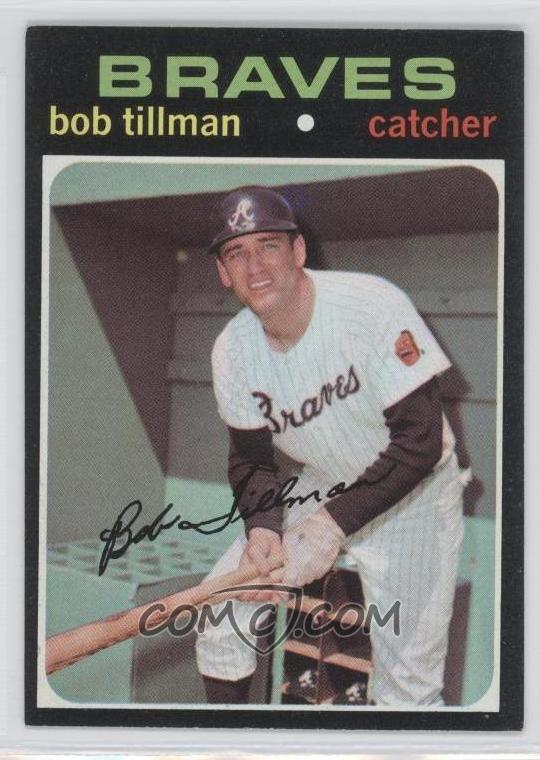
There’s very little that’s notable about this card of Bob Tillman other than the catcher’s mitt that appears to be freakishly large. Tillman was a catcher who played nine seasons in MLB mostly because he was a catcher. His similar batters list includes legends of the game like Kelly Stinnett and Damon Berryhill.
To be fair, Tillman actually had a very good 1964 season. He set career highs in pretty much every category, catching 131 games for the 72-90 Red Sox. He had 17 homers, 61 RBIs and a .796 OPS (116 OPS+). It was the only season in which he collected more than 100 hits (he had 118).
Otherwise, Tillman was a part-time player who never really did much offensively. His greatest claim to fame is catching no-hitters thrown by Earl Wilson (1962) and Dave Morehead (1965).
He hit for some power in the minors (including 24 HR in AAA in 1960), and followed that up with a rookie season with the Red Sox in which he hit 14 HR in only 273 PA. It’s clear the Red Sox expected him to be a slugger, because he hit fourth in his first two career starts. Tillman homered in his first official at-bat (he walked twice before that).
But he wasn’t very good in ’63, and after the strong ’64 campaign he tanked in ’65 and ’66.
Midway through the 1967 season, the Red Sox let Tillman go to the Yankees. After playing sparingly in New York, the Yanks traded him to the Atlanta Braves for a young third baseman named Bobby Cox.
In three seasons as a part-timer with the Braves, Tillman hit a not-terrible 28 homers in 711 PA, but he posted a terrible .211 average, .281 OBP and 14 doubles.
The Braves traded him to the Brewers in December 1970, and the Brewers released him February 1971, two months before the season started. For some reason, Topps made a 1971 card for him showing him as a Brave. I guess they didn’t get the memo.
Tillman died of a heart attack in 2000 at the age of 63.
#35 Ed Mathews


This is a card I’ve had for more than 20 years. I got it in a binder full of old cards I bought at a card show. The binder also included a 1954 Mathews, which I’ve since sold. The slightly frayed left edge, I believe, is a result of how the card was originally cut. Otherwise, the card’s in pretty good shape. As always, his name appears as “Ed” on his card. As far as I can tell, each of his Topps cards from 1952 through 1968 showed him as Ed Mathews, although a couple of his All-Star cards show his name as Eddie Mathews. When he managed the Braves in 1973 and ’74, his name was listed on his cards as Eddie Mathews. Mathews was the Braves manager when his longtime teammate, Hank Aaron, hit his 715th homer.
At the beginning of the 1964 season, Mathews was the active leader in career homers at 422 (Stan Musial retired with 475 after the 1963 season). That also ranked him seventh all-time at that moment. He would hit 90 more home runs over the last five years of his career, before retiring as a Detroit Tiger in 1968. His 500th long ball came as a member of the Houston Astros in 1967.
Mathews was just the seventh player to hit 500 homers, and he was in the top 10 in career homers from 1961 through 1985, when he was finally bumped off by Reggie Jackson. Though he led all active players at the opening of the 1964 season, he would eventually be passed on the career list by five players who were active in 1964: Aaron, Willie Mays, Frank Robinson, Harmon Killebrew and Mickey Mantle. Ernie Banks finished tied with Mathews at 512.
Mathews was also the only player to play for the Braves in three different cities. The team still played in Boston when he was a 20-year-old rookie in 1952, and he was still with the team when it moved from Milwaukee to Atlanta in 1966.
Astonishingly, it took FIVE years of eligibility before Mathews was voted into the Hall of Fame, despite the fact that he’s clearly one of the best hitters of all-time, especially among third basemen. I suppose what turned voters off at the time is the fact that he ended up with a .271 career average, a number that was dragged down in his last five years. He also, of course, played with Aaron, and never was the most notable player on his own team. But for a solid dozen seasons, Mathews was an absolute beast at the plate.

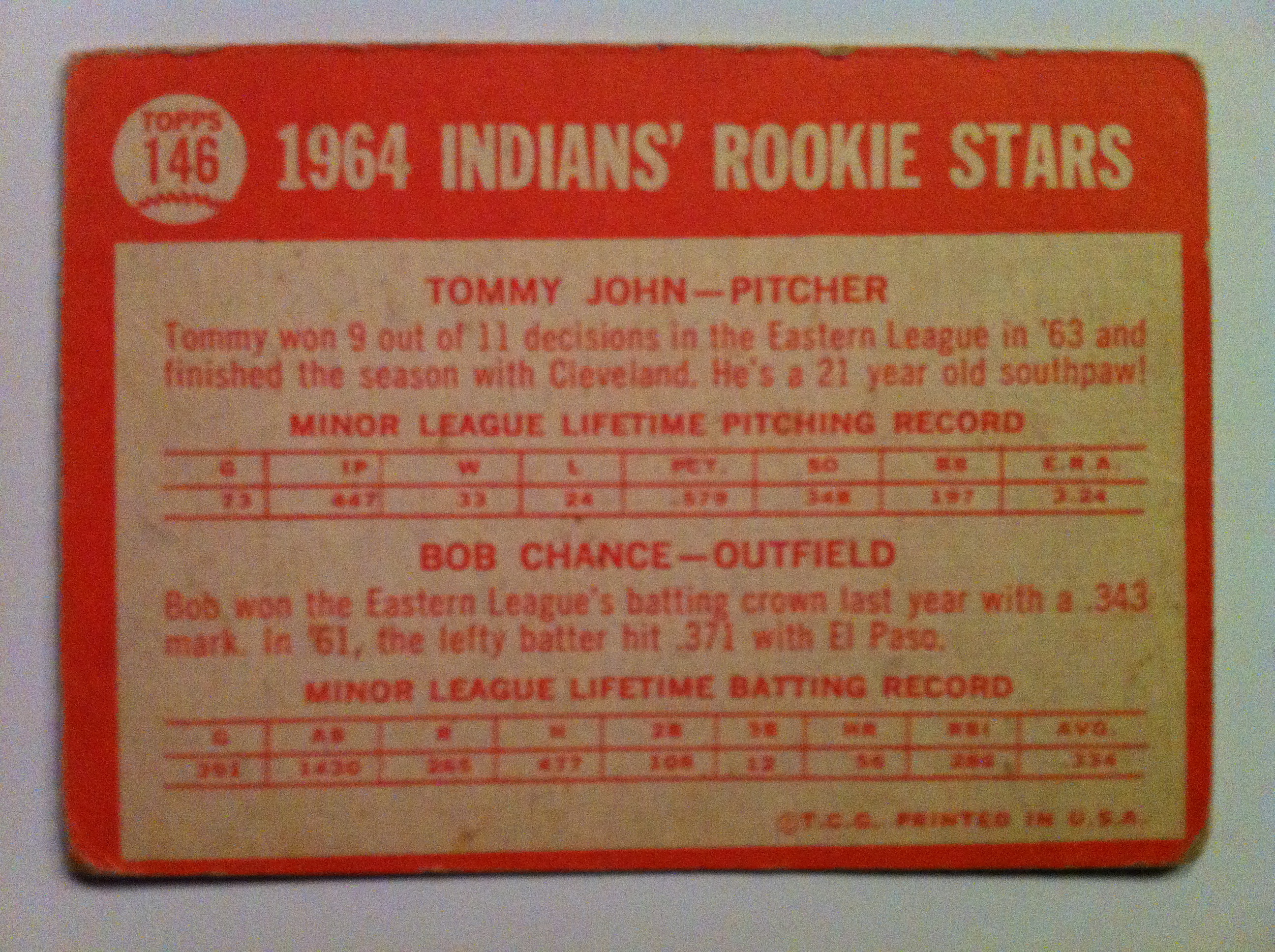
More than just a surgery, Tommy John is depicted here on his rookie card alongside 1B/OF Bob Chance, who played 20 fewer seasons and actually had fewer plate appearances as a hitter than John.
This is probably one of the worst cards I have, condition-wise. But it was dirt cheap so I picked it up a couple years ago.
Much is written about Tommy John (so I’ll focus here on 1964 instead of his full career), who pitched for 26 years and was rejuvenated after undergoing the elbow ligament-replacement procedure that came to bear his name. To put John’s longevity in perspective, he was an active player until 1989. No other player depicted in the 1964 set was still playing that recently (he outlasted Pete Rose by three seasons). John reportedly decided to hang it up at age 46 when he gave up a home run to Mark McGwire, whose dad was his dentist.
This card is the only one to portray John in Indians gear. He came up late in the 1963 season as a 20-year-old and pitched pretty well in 20 2/3 innings, and that earned him a spot in the Cleveland rotation in 1964.
The 1964 season started out great for John, who threw a complete-game, three-hit shutout against the Orioles in his first start of the season. Things went south from there, and he only lasted 1/3 of an inning the next time out. He didn’t pitch all that poorly after that, allowing three or fewer earned runs in six consecutive starts from June 3 – July 1. Unfortunately, he lost all six starts (the Indians offense was a bit anemic). After an awful start against Kansas City on July 16 (which, ironically, earned him a no decision), the Indians sent John to the Portland Beavers in the PCL. He returned to work out of the bullpen for the last two weeks of the season, and never pitched for Cleveland again. He finished with a 2-9 record and 3.91 ERA (93 ERA+) in 1964. He wouldn’t post an ERA+ of under 100 in a season again until 1983, when he was 40.
In the offseason, the Indians shipped John and others to the White Sox in a three-team deal that brought Rocky Colavito back to Cleveland from Kansas City. Colavito had two more good seasons with the Indians before fading into oblivion, while John put up seven solid seasons in Chicago before being traded to the Dodgers.
John is currently 69 years old.
Like John, Bob Chance was a call-up late in the 1963 season. Chance was awesome in the AA Eastern League that season, winning the triple crown with a .343 average, 26 HR and 114 RBI. He looked like a future star, and had a promising rookie season with the Indians in 1964, delivering a .279/.346/.433 line as a 23-year-old in 439 PA with 14 homers and 75 RBI, while playing mostly first base. The big rookie year earned him a Topps All-Star Rookie trophy on his 1965 card.


Both guys on this card had outstanding rookie seasons in 1964, then somewhat fell off the map in subsequent years.
The descent was worse for Bowens, who was the starting right fielder for an O’s team that won 97 games in ’64. He finished third on the team (behind Boog Powell and Brooks Robinson) with 22 home runs and 71 RBI, and posted a decent .263/.323/.453 line in 553 plate appearances.
That was basically it for Bowens, who basically became unable to hit over the last five seasons of his career. As a part-time player from 1965-69, he batted an awful .188 over 814 plate appearances, with only 22 homers and 20 doubles over that span. He was noted for his defense, and he earned a World Series ring for Baltimore in 1966 despite not playing in the Series.
The Orioles finally had enough after the 1967 season and sold him to the Washington Senators, for whom he toiled in misery for two more seasons. He played in minor league ball in the Braves and Pirates’ systems in 1970, but called it quits when he never got called back up the big leagues.
Bowens died at age 65 in 2003.
Wally Bunker had a much better career than Bowens, but his standout season also came in 1964. As a 19-year-old, Bunker went 19-5 with a 2.69 ERA (a 134 ERA+). He threw two one-hitters before the All-Star break and became an instant sensation in Baltimore, where the mound became known as “Bunker Hill” when he started.
#302 Dan Pfister


Before there was Doug Fister, there was Dan Pfister. This is the third and final Topps card featuring Pfister, who last played in the Major Leagues in 1964. His 1962 rookie card was a five-player combo card also featuring Jim Bouton.
Like the cards for several other A’s in the ’64 set, the photo used here was actually taken in 1962. Kansas City ditched the red/blue color scheme after the ’62 season and went to the familiar green/yellow combination that we associate with the A’s today. In fact, this card just reuses the photo from his 1963 Topps card.
The question on the back asks “what was the biggest score of a ballgame?” The answer is the same now as it was in 1964: on August 25, 1922, the Cubs beat the Phillies 26-23 in the highest-scoring game ever. The most a single team has scored in the World Series era is 30, which the Rangers put up August 22, 2007 against Baltimore (the final was 30-3). That game is also notable in that Texas pitcher Wes Littleton earned a save for pitching the last three innings in a game his team won by 27 runs (although it was “only” 14-3 when he entered the game).
Dan Pfister pitched in parts of four seasons with the A’s, and the vast majority of his 249.1 career innings came in 1962, when he started 25 games and went 4-14 with a 4.54 ERA, 1.431 WHIP, OK enough 8.0 H/9 and icky 1.16 K/BB ratio. In his first career start, he threw a complete game three-hitter but lost 1-0 to Detroit.
He worked his way through the KC system, starting in 1957. He didn’t pitch particularly well at any level and was hideous in AA in 1961, but since the A’s were terrible he got a cup of coffee with the team that season in September.
After a full season in ’62, he made only three appearances in 1963 before being shut down for the season (presumably due to injury but I have no confirmation as to why he didn’t pitch after April 27).
He returned in 1964 as a reliever and spot starter, but after posting a 6.53 ERA in 41.1 IP with 29 walks, 21 strikeouts and 10 homers allowed, he was done as a big leaguer as of July 31. He went to AAA and pitched fairly well, but by 1965 was demoted to AA. Pfister was out of pro ball at age 28.
After retiring, he became a firefighter in Hollywood, Florida, and also turned into an avid softball player. In 1994, he went with an over-55 softball team to a world series in Las Vegas.
Pfister is currently 75 years old.
#200 Sandy Koufax

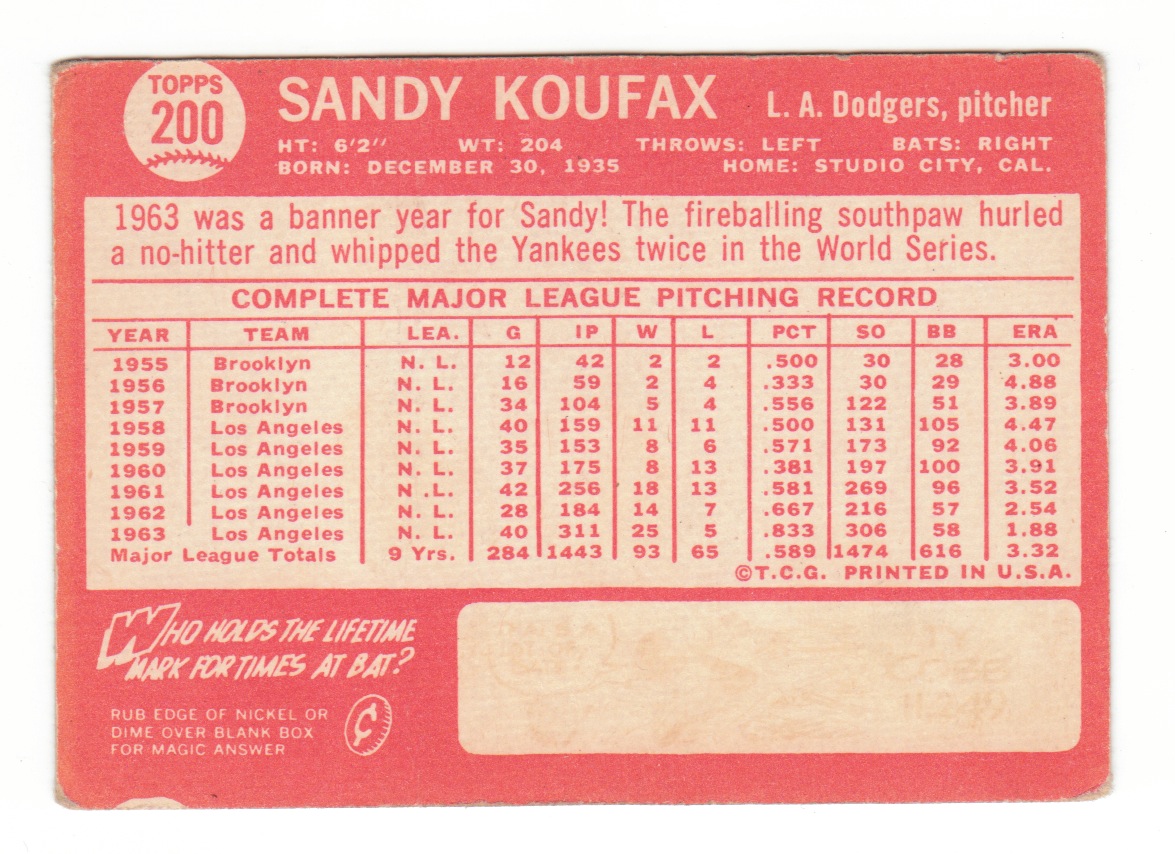
From the scan, this card looks pretty good. But it is creased right through the upper half of Koufax’s face, which knocked it down into a good price range for me to pick up a couple of years ago.
The trivia question asks “who holds the lifetime mark for times at bat?” Now, I’m not sure if Topps meant plate appearances or at bats, but the answer in 1964 would’ve been the same: Ty Cobb. In terms of at bats, Cobb broke Honus Wagner’s record in 1926 and finished with 11,434. He held the record until 1974, when he was passed by Hank Aaron. Pete Rose passed Aaron in 1982 and still holds the record at 14,053. The story is much the same in plate appearances. Cobb clipped Wagner’s mark in late 1925, and he again held the record until 1974 at 13,068. Again, Aaron took over the record in 1974 and held it until Rose broke it in 1982. Rose still holds the record at 15,861.
There’s not much that can be said about Sandy Koufax that hasn’t been said elsewhere. Koufax is of course considered one of the greatest pitchers in baseball history despite a general lack of longevity. But until 1963, his numbers were not spectacular, largely due to a lack of control. His stat line from 1955 through 1962 looks like this:
68W, 60L, 3.71 ERA, 110 ERA+, 1.31 WHIP, 7.4 H/9, 4.4 BB/9, 9.3 K/9, 1.0 HR/9
Now, these aren’t terrible numbers, but it doesn’t look like he’s headed for a HOF career at this point, although the strikeout rate and hit rates are nice. 1962 is really where things started to turn around for him, when he got the walk rate down to 2.8 and had a career-high K rate of 10.5. He also led the NL in ERA at 2.54, despite having to miss some starts due to a hand injury. This was to some degree affected by the Dodgers moving from the L.A. Coliseum to Dodger Stadium, a move that greatly favored pitchers in general.
In 1963, Koufax began what is likely the most dominant four-year stretch by a modern pitcher. The numbers from those years (the last four of his career):
97 W, 27 L, 1.86 ERA, 172 ERA+, 0.91 WHIP, 6.2 H/9, 2.0 BB/9, 9.3 K/9, 0.6 HR/9
 The 1964 Topps Blog